The Moravian-Silesian Region, together with the Faculty of Materials Science and Technology of VŠB – Technical University of Ostrava (FMT VŠB–TUO) and the contributory organisation Black Cube, has entered into a memorandum of cooperation on the establishment of the open data platform cerna.envi.ai. The platform is intended to fundamentally transform the way environmental data are handled in the region and to support access to European funding for a just transition. The first pilot project will be the planned Ostrava-Karviná tram line.
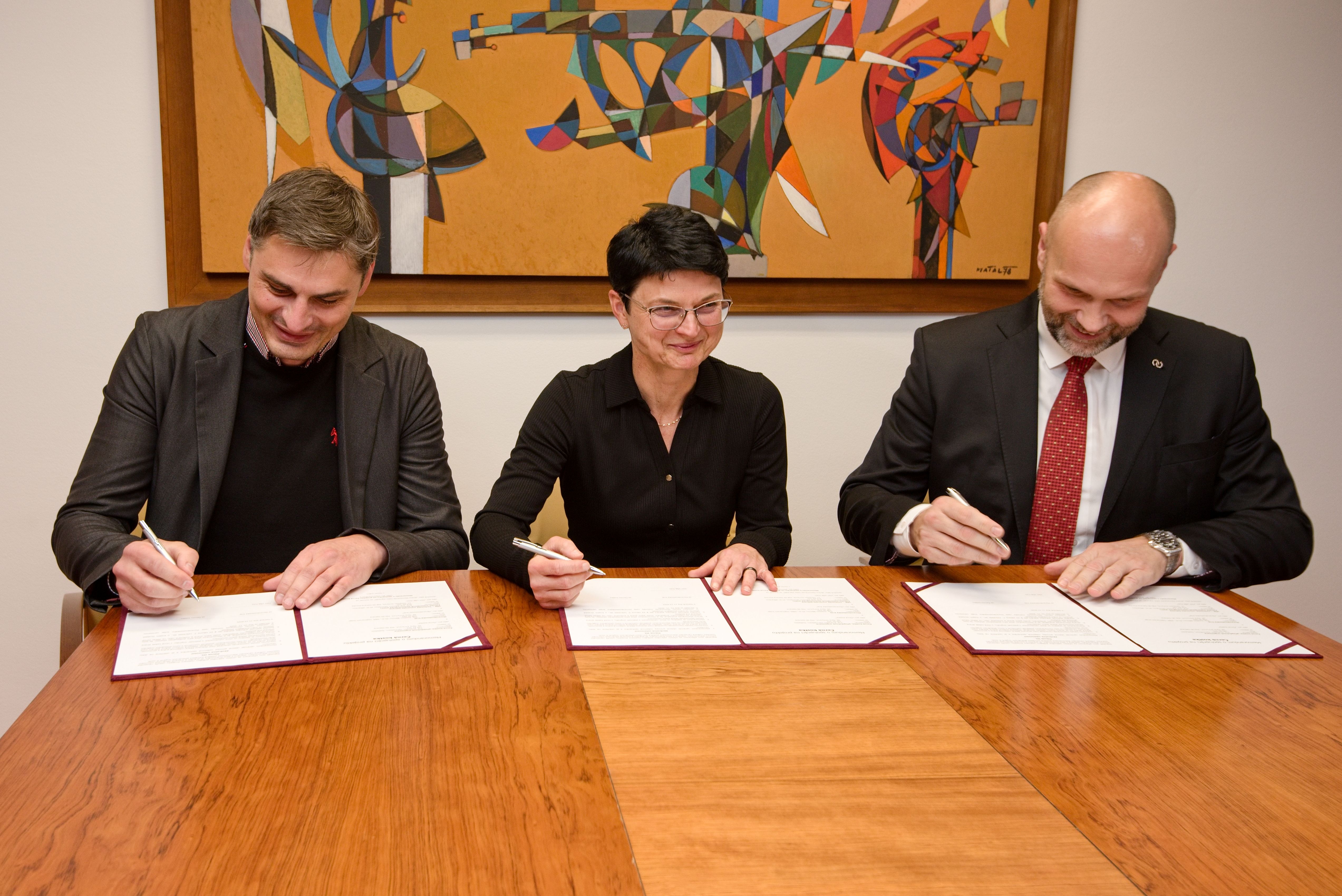
The Moravian-Silesian Region, the Faculty of Materials Science and Technology of VŠB-TUO and the contributory organisation Black Cube have jointly signed a tripartite memorandum of cooperation. Its objective is to build the open data platform cerna.envi.ai, which is to become the foundation of the very first regional ESG data infrastructure in the Czech Republic.
The cerna.envi.ai platform will enable regional authorities, municipalities and companies to work more effectively with data on emissions, energy, transport, air quality and sustainability. “This unified dataset will be open and auditable. In one place, it will provide information that will help us plan investments more accurately, better target measures with the greatest impact on quality of life in our region, and more easily demonstrate the environmental benefits of projects within European funding frameworks. This new platform will also support the modernisation of the region, open up space for new services and innovations, and strengthen links between the region and the research teams of VŠB-TUO,” summarises Josef Bělica, Governor of the Moravian-Silesian Region.
Open ESG data infrastructure for the region and businesses
The cerna.envi.ai project will create an open and auditable dataset of environmental and emissions data based on verified national and European sources such as the Czech Statistical Office, the Ministry of Industry and Trade, the Ministry of the Environment, CENIA and relevant European registers. The data will be standardised according to European classifications (EFRAG, XBRL, NACE) and designed to be usable by public administration, investors and businesses alike.
Strong emphasis is also placed on compliance with European legislation. The data infrastructure will be prepared for integration with Digital Product Passports and for requirements arising from the CSRD, ESPR and CBAM directives and regulations. As a result, the Moravian-Silesian Region will gain a tool enabling the long-term and systematic monitoring of the impacts of policies in the areas of climate, energy, transport and climate change adaptation.
“The Moravian-Silesian Region has produced dozens of strategic documents and studies, but it has often lacked a shared data foundation to build upon. The cerna.envi.ai project fills this gap – it connects data from various sources, translates them into comprehensible outputs and makes them accessible to officials, experts and investors alike,” says Andrej Harmečko, Director of the contributory organisation Black Cube.
A tool for the just transition of the region
The Moravian-Silesian Region is among the main recipients of funding for a just transition and has long been under pressure from both European climate policy and market changes. To secure support from EU funds, it is increasingly necessary to demonstrate concrete project benefits for climate protection, air quality and greenhouse gas emission reductions.
The cerna.envi.ai platform is intended to serve as a practical tool for managing this transformation. It will enable the evaluation of impacts at the regional, municipal and individual project levels, the comparison of different development scenarios, and the preparation of high-quality data inputs for applications for European funding. As a result, decision-making on future investments will be based on transparent and verifiable data.

Pilot project: Ostrava–Karviná tram line
The first pilot project of the new data platform will be the strategic regional project of the Ostrava-Karviná tram line. This is a flagship project in the field of sustainable mobility, building on the transport concepts of the city and the region, particularly the TEN-T network and the Sustainable Urban Mobility Plan (SUMP) of Ostrava. The new line will connect Ostrava with Karviná and contribute to meeting decarbonisation targets for 2027 and 2030.
“The tram line is a suitable pilot project for testing the cerna.envi.ai platform primarily because it has clearly measurable environmental benefits and meets the conditions for European funding from programmes such as CEF, the Just Transition Fund or the Transport Operational Programme. Moreover, it involves multiple municipalities and institutions, making it an ideal model for working with data at the regional level. It will allow the practical verification of advanced data tools, including AI models for predictions, development scenarios and detailed analyses of impacts on climate and quality of life,” says Kamila Janovská, Dean of the Faculty of Materials Science and Technology of VŠB-TUO.
The tram line will have a direct impact on CO₂ and nitrogen oxide emissions, noise levels in the affected municipalities, and the modal split between individual car transport and public transport. From the perspective of EU policy, this is the type of project that the European Union has long identified as a model decarbonisation measure in transport.
It is expected that the tram line will lead to a reduction in individual car transport between Ostrava and Karviná and save thousands of tonnes of CO₂ emissions annually – model calculations indicate up to 6,600 tonnes of CO₂ per year. The project should contribute to improving air quality in one of the most environmentally burdened regions of the Czech Republic while also offering fast and reliable connections for work, education and services for residents of the affected cities and municipalities.
Division of roles under the memorandum
Within the project, the Moravian-Silesian Region will primarily ensure access to data at the regional, municipal and regional organisation levels and define priorities in the areas of climate, mobility, energy and climate change adaptation. The region will use outputs from the cerna.envi.ai platform for investment management, development planning, financing decisions and reporting obligations towards the state and European institutions.
VŠB – Technical University of Ostrava, FMST, through its Department of Industrial Systems Management and the Net Zero Lab, will provide expert leadership in ESG methodologies, impact modelling and data validation. It will involve academic teams and students and participate in the development of the technical infrastructure of the platform, including AI modules and analytical tools.
The contributory organisation Black Cube, through the cerna.envi.ai project, will build the open ESG dataset for the Moravian-Silesian Region, develop AI-based tools for reporting, prediction and analysis, and design user interfaces for public administration, companies and the professional community to make working with complex data as accessible as possible.
About the Black Cube project:
Černá kostka is a newly emerging building in the centre of Ostrava, conceived as a hub for education, digitalisation, science and innovation. The project transforms the traditional concept of a library into a multifunctional centre that connects librarianship with technology within a thoughtfully designed space for learning, work and meetings. The construction of Černá kostka represents one of the largest investments of the Moravian-Silesian Region and is being implemented as part of the Černá kostka – Centre of Digitalisation, Science and Innovation project, co-financed by the European Union through the Just Transition Operational Programme, managed by the Ministry of the Environment of the Czech Republic. The project is also co-financed from the regional budget and the budget of the Statutory City of Ostrava.
More information about the project can be found on the Black Cube website: www.cerna-kostka.cz/en.
About the cerna.envi.ai project:
The cerna.envi.ai project is a newly emerging open data platform focused on environmental and ESG data for the Moravian-Silesian Region. Its aim is to consolidate verified information on emissions, energy, transport, air quality and related climate impacts in one place and enable the region, municipalities and companies to make decisions based on accurate data.
The platform is intended to function as a regional “data backbone” for the just transition. It will use data from national and European sources (e.g. the Czech Statistical Office, the Ministry of Industry and Trade, the Ministry of the Environment, CENIA, European registers), standardise them according to European classifications (EFRAG, XBRL, NACE), and prepare them to meet the requirements of current legislation (CSRD, ESPR, CBAM) as well as newly introduced tools such as Digital Product Passports.
The project is being developed under the contributory organisation Black Cube in cooperation with the Moravian-Silesian Region and VŠB – Technical University of Ostrava (Net Zero Lab). The first pilot use case of the data platform is the planned Ostrava–Karviná tram line, where the project will test how accurately the environmental benefits of large infrastructure projects can be measured and modelled.